
Before any prose or wit spills onto the page, credit needs to be given where it’s due.
Some of the letter-level observations and Hebrew reflections that sparked this line of thinking came from Jalein Abania. She explores this territory primarily in video form—and she does so thoughtfully and responsibly. If this kind of meditation on Scripture intrigues you, I strongly encourage you to check out her work and subscribe to her YouTube channel ➔ https://www.youtube.com/@jaleinabania.
What follows is not an attempt to turn Scripture into a secret codebook. It’s a written reflection, running alongside the larger study we’re doing in John, which is how I came upon Jalein’s video (turning over rocks or overturning tables if you will)—offered as a companion thought, not a controlling lens.
Exegetical Reading of John 1:1 ➝ Voiding the Fritter and Waste of Beginning in an Offhand Way
Christian theology does not abide in hidden messages, letter symbolism, or numerical patterns, but rather on what the text actually says, read in context, grounded in grammar, history, and the full witness of Scripture.
That said… Scripture also invites meditation. And meditation, when tethered to truth, often reveals depth, not novelty.
So think of this as a seed, not a cipher.
An echo, not an argument.
Why “In the Beginning” Stops Me Cold
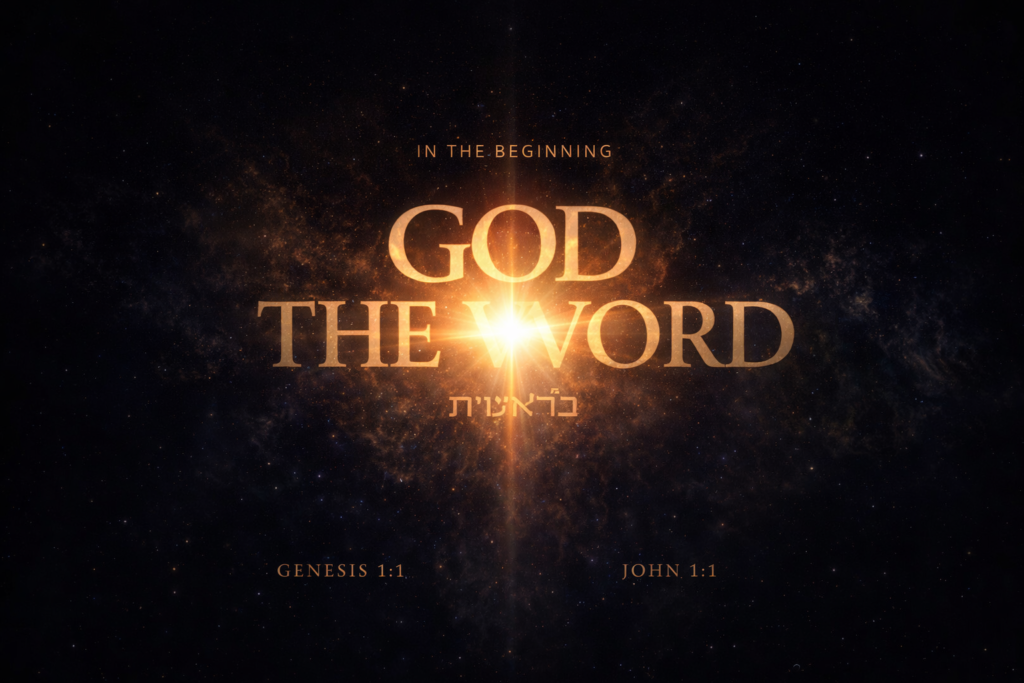
The Bible doesn’t open with a warm-up. It opens with בְּרֵאשִׁית — In the beginning.
Not a moral lesson.
Not a genealogy.
Not a set of instructions.
A declaration.
The Bible contains a vast—commonly cited as more than 5,000—network of cross-references linking the Old Testament and New Testament, directly and indirectly.
Others have mused on the numbers tied to the letters of the Hebrew alphabet, containing biblical math that translate and reveal truth in a way that cannot reasonably be argued as circumchance.
Many have delved deep into how scripture reveals and resolves scripture. And specifically how everything in the Bible, from the very first clause of Genesis through the end of Revelation, points to Christ, the incarnate and living Son from the Father, full of grace and truth, and our only means to eternal life with the Father.
Patterns repeat. Themes resolve. Earlier truths bloom later. None of that is accidental.
And if you go down any of these rabbit holes—
“You may find yourself—
“Into the blue again,
into the silent water...”
And you may ask yourself, ‘Well, how did I get here?'”
But sometimes—in fact—often, it serves us well to remain there and abide in what is being revealed to you by The Spirit.
Are all of those connections airtight? No.
Are they meaningless? I don’t think so.
Scripture itself treats beginnings this way.
Seeds matter.
First words matter.
God does not waste openings—because they matter.
John certainly didn’t.
When John opens his Gospel with “In the beginning”, he is not being poetic. He is being surgical.
He reaches back to Genesis and says, in effect: That beginning? I’m going to tell you what, or more appropriately, who was already there.
Not chaos.
Not potential.
The Word.
And not merely spoken, but present.
Not created, but existing.
Not distant, but with God.
Not lesser, but God.
Whatever else Genesis 1:1 may contain, John tells us this much with certainty: the entire story was always moving toward Jesus.
So no, I’m not claiming Genesis 1:1 secretly encodes the gospel of our salvific redemption, but I am rightly comfortable saying this:
It is not unreasonable to believe that the opening words of scripture reveal and confirm the gospel they will eventually proclaim. If the first line of scripture whispers that story before it shouts it later, that doesn’t diminish truth. It magnifies it.
And while I believe that the gospel is proclaimed—and revealed, not deciphered—
I do not believe Scripture is thin or light—
And we are instructed to meditate on His Word day and night.
Now, I am not a symbologist. I am not a cryptologist. And I am certainly no Robert Langdon.
But I do not have to be to know the same God who wove prophecy across centuries—echoed themes through covenants—and fulfilled promises with breathtaking precision is fully capable of saturating His Word with layered meaning—meaning that rewards reverent attention without requiring secret knowledge.
So to you, dear reader, I submit this—
Not as doctrine—
Not as proof—
But as wonder—submitted to the authority of the text, not elevated above it.
Sometimes, bathing in the richness of Scripture reminds us just how intentional the biblical story has always been.
At this point, I might say caveat emptor—a word of caution to the reader.
Think of this reflection like a stained‑glass window set into the cathedral wall of Scripture. Some will step close, tracing individual panes—the shape of a letter, the texture of a word, the way light bends through a particular color. Others will stand back and simply take in the whole—light, form, and beauty together—without pausing over the craftsmanship. The window is not the foundation. It does not hold the building up. But when the light passes through it, it can illuminate the space in a way plain glass never does.
With that understanding in place, the phrase In the beginning (בְּרֵאשִׁית) consists of six Hebrew letters: Bet (ב), Resh (ר), Aleph (א), Shin (ש), Yod (י), and Tav (ת). And in these we find foundational symbols in both Genesis and the Gospel of John, echoing profound theological themes. What matters here is not the individual letters themselves, but the theological direction they suggest when read together.
Genesis speaks of formlessness in the deep—chaos before order—but even there, God is not absent. His Spirit hovers over the quiet water, and by His Word He speaks creation into existence.
John tells us plainly what Genesis whispers poetically: the beginning was never empty. It was already oriented toward revelation.
A Seed or Ralphie’s Substitution Cipher
- The Son of God:
- From Bet (ב) for “house/creation,” and through Resh (ר) for “head/beginning,” whose root leads us to Ben (son).
- Aleph (א) gestures toward the unseen source—the breath behind speech, the strength beneath action. Its quiet presence reminds the reader that what follows originates in God Himself.
- Destroyed by His own hand on the cross:
- Shin (ש) can signify destruction that leads to transformation.
- Yod (י) symbolically related to the concept of “hand.” It signifies action.
- Read meditatively, Shin and Yod together evoke decisive action through suffering. John will later insist that the Light’s decisive action occurs not through conquest but through self-giving (John 12:24; 13:1)—a pattern that makes such resonance intelligible, even if unintended.
- Bearing thorns upon His head:
- Shin (ש) has a distinctive three-pronged shape, which visually suggests sharpness or points, akin to thorns. It also may be representative of the challenges or obstacles faced during His crucifixion.
- Gift of the covenant:
- In its ancient form, Tav (ת) was drawn as a cross-shaped mark. Biblically, it often signifies a boundary, a seal, or a covenantal sign.
- Revisiting the combination of Shin (ש) and Yod (י) leads to the idea of “gift,” emphasizing the divine promise.
- Resurrection and promise of renewal:
- Incorporating the transformative side of Shin (ש), signifying rebirth and renewal following destruction (resurrection).
And This is the Gospel of Our Salvation
“The Son of God, represented in the house of creation, is destroyed by His own hand on the cross, bearing thorns upon His head; yet, this sacrifice is a gift of the covenant, leading to His resurrection and the promise of renewal.”
The six Hebrew letters that form בְּרֵאשִׁית (“In the beginning”) do more than introduce John’s Gospel—they introduce Scripture itself. Read together, they frame a cohesive spiritual narrative of creation, sacrifice, divine gift, and renewal, reverberating through the Hebrew Bible and finding full voice in the Christian Gospel.
“Same as it ever was, same as it ever was…”
Back to the front ➝ Voiding the Fritter and Waste of Beginning in an Offhand Way.