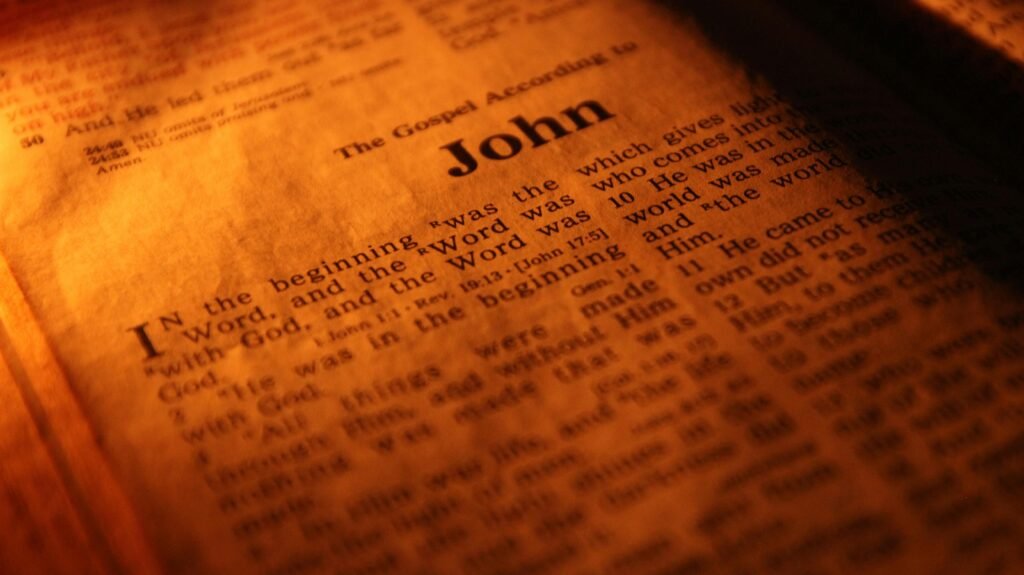
John’s Greek is famously simple — almost stubbornly plain — and this is evident in the first verse of John 1.
"In the beginning was The Word,
and The Word was with God,
and The Word was God."
(John 1:1)
His vocabulary is limited. His syntax is repetitive. He is not writing to win rhetoric prizes in Alexandria. Anyone familiar with Hebrew Scripture recognizes the repetition — especially where repetition safeguards meaning.
Think:
Genesis 1 (“And God said… and it was so”)
The Covenant restatements in Deuteronomy
The Psalms’ parallelism
Prophetic oracles that declare identity before action
Hebrew writing repeats not to embellish, but to stabilize.
It is the repetition of 1:2 that holds these truths in place, while you are still recovering from the grammatical trespass of 1:1 on your gray matter. John is not covertly suggesting rhythm. He is reinforcing pattern, coherence, and time.
John makes no demand of the reader. He signals that these truths bear repeating — so that belief may come even before comprehension. In doing so, he places himself under the same claims, trusting their source will not forsake him.
The claims John makes in 1:1 are dangerously expansive. 1:2 narrows the interpretive drift.
Let my inspiration flow In token lines suggesting rhythm…
He Was There In The Beginning
The King James translators slow us down in a way modern ears sometimes miss:
The Same was in the beginning with God.
John 1:2
Greek (Koine) οὗτος ἦν ἐν ἀρχῇ πρὸς τὸν θεόν(houtos ēn en archē pros ton theon)
οὗτος (houtos) is demonstrative — insistent.
Notanother. Notsomething similar. Thisone.
This very one — just named, just described, just confessed — the same — wasin the beginning with God.
John settles the matter and closes the door on theological sleight of hand. Before the reader has opportunity to register λόγος (Logos) as the subject, John quiets any impulse to substitute a lesser one in verse 2.
The Word who was with God and was God is not a preliminary sketch that gets revised when creation begins.
The sameWord stands here.
Repetition here is not redundancy; it is identity preservation. John repeats himself so the reader has no opportunity to revise him.
“The same” also resists abstraction.
He is not talking about an attribute of God. Not a divine impulse. Not a metaphysical principle that floats free once it has done its work.
John is pointing back — almost with his finger — to The Wordalready introduced. That one.
This phrasing also preserves relationship without dilution.
“With God” still carries its weight: distinction without distance, communion without competition.
The Word iseternally oriented toward God, not temporarily aligned for a task.
Creation will happen through Him, but He does not come into being for it.
John makes sure we are still looking at the same figure before anything begins.
‘Til things we’ve never seen Will seem familiar…
All Things Were Made Through Him
With identity secured in verses 1–2, John now discloses action in verse 3 — what The Word does flows from who The Word is.
If John 1:2 steadies us, John 1:3 moves us forward.
All things were made through Him, and without Him was not any thing made that was made.
John 1:3
Greek (Koine) πάντα δι’ αὐτοῦ ἐγένετο (pánta di’ autoû egéneto,) καὶ χωρὶς αὐτοῦ ἐγένετο οὐδὲ ἕν ὃ γέγονεν (kai chōrìs autoû egéneto oudè hén ho gégonen)
With verse 3, John finally allows creation to appear — but only after he has secured the identity of the One through whom it comes.
The verb changes decisively.
Where verses 1–2 repeatedly use ἦν (“was”) to describe the eternal existence of The Word, verse 3 introduces ἐγένετο (“came into being”). This contrast is not stylistic; it is theological. John draws a clear distinction between what eternally is and what comes into existence.
Everythingthat is notThe Wordbelongs to the latter category.
All Things (πάντα / pánta)
John’s vocabulary may be simple — his precision is not.
πάντα means all things
—notmost things, —not only spiritual things,
—but all of creation: matter and energy, time and space, visible and invisible.
While the storyteller speaks A door within the fire creaks Suddenly flies open
This claim echoes Genesis 1 in its totality…
"In the beginning, God created the heavens and the earth." (Genesis 1:1)
John now identifies the divine agent through whom that creation occurred.
Through Him (δι’ αὐτοῦ / di’ autoû)
The preposition διά with the genitive denotes agency. The Word is not a passive instrument nor a secondary cause. Creation does not happen apart from Him, nor alongside Him, but through Him as the active mediator of divine will.
John’s phrasing carefully preserves monotheism while revealing personal distinction: God creates, but He creates through The Word.
Without Him… Not One Thing (χωρὶς αὐτοῦ… οὐδὲ ἕν)
John then restates the claim negatively, a characteristic Hebraic intensification:
The juxtaposition of these two clauses is not redundant — but exhaustive. By denying even a single exception (οὐδὲ ἕν), John forecloses every attempt to place The Word inside the created order.
If even one created thing existed apart from The Word, His status as Creator would collapse.
John allows no such opening.
The Logos eternally exists outside creation and yet mediates its existence.
Nothing that exists does so apart from Him.
Creation is notautonomous. Creation is notself-generating. Creation is noteternal.
Creation is contingent — dependent at every point on The Word who already was.
The storyteller makes no choice Soon you will not hear his voice…
This claim is not unique to John. Scripture consistently attributes creation to the eternal Lord — a truth the New Testament explicitly applies to the Son.
"Of old you laid the foundation of the earth,
and the heavens are the work of your hands.
They will perish, but you will remain ...
but you are the same, and your years have no end."
(Psalm 102:25-27)
Originally addressed to YHWH, this passage is later applied directly to the Son:
"Long ago, at many times and in many ways, God spoke to our fathers by the prophets,
but in these last days He has spoken to us by His Son,
whom He appointed the heir of all things,
through whom also He created the world."
(Hebrews 1:1-2)
This is creation called into being by The Word—not as arbitrary—not as תֹהוּ וָבֹהוּ (tohu vavohu “without form and void”) — but as will-inspired order.
Creation is spoken into existence by the One who knows us before we know ourselves.
This is where John quietly challenges us.
The same Word through whom all things were made will step into the thing He made — as a beacon to lead us home through the darkness.
But John is not there yet — though the path he is tracing already bends toward a moment when the eternal Storyteller will no longer remain at a distance.
For now, he wants us to abide in the staggering claim:
Everything that exists owes its existence to The Word who was with God in the beginning.