Reading Scripture Unapologetically — Tired of lying in the sunshine …
This is #1 in the exegesis of John. If you have not, we encourage you to start here ➝ Revelations of Exegesis
I did not come to this in passing. I am not a toe-tipper or a try-before-you-buy kind of guy. I was raised Catholic. Catholic church. Catholic mass. Catholic school. I even found myself, for the better part of a semester, seated in Sister Bartholomew’s coat closet. A merciful intervention, I suspect, because then, even more than now, I had trouble keeping my tongue from wagging with all the important things I was convinced needed saying. I knew when to stand, when to sit, when to kneel, and when to say “Amen.” I knew the pomp and circumstance of the Catholic mass long before I ever sat still enough to hear the word.
Ticking away The moments that make up a dull day
But being around the word is not the same thing as being inThe Word — abiding there.
That distinction did not hit me until I was well into my fifth decade on this earth. And not because I suddenly discovered God. Nor because of a dramatic crisis nor spiritual spectacle. There was no “come to Jesus” moment for me. It was the mere suggestion of a college buddy to begin anew with John in Scripture.
So I did.
I sat in my reading chair. I opened a Bible to the Book of John. And I read — just as I had on several occasions before.
I did not change my approach. I did not unlock some hidden method. In fact, I did nothing different.
What changed was not what I did, but what the Spirit of God did. By the grace of God — and the faithful prayers of friends — the word was finally revealed as The Word. And when it happened—when the significance — indeed the Majesty of The Word was revealed to me — it rewired how I looked at Scripture.
Full stop.
Waiting for someone Or something to show you the way
Over the years, the word was flexible, disposable, and endlessly negotiable. Just about everything has been called “the word.”
The Bird was the word. Grease was the word. The word was love.
“Word” became slang for agreement — approval — authenticity — whatever the moment needed, it was.
We spread the word. We spin the word. We weaponize the word. We redefine the word.
And then, we define ourselves by it.
John will have none of that.
He does not offer a slogan, nor a metaphor, nor a vibe. He presents The Word as eternal, personal, and unyielding — something that is not revised, rebranded, nor bent to fit your feelings. Before culture ever got its mitts on “the word,” John declares that The Word already was.
The reader is not eased into the fourth book of the New Testament. John 1:1 does not ask permission. It gets right up in your crawl space. And we find out very early that John is also not one to dip his toes. Three words into his book — In the beginning — he is already in it up to his neck.
It is not an icebreaker. It is not a poetic warm-up. It is not a theological conversation starter.
It is one of the boldest — and, to modern ears, most outlandish — claims ever put to parchment.
Claims rooted in truth are not measured by whether they offend or unsettle. They stand or fall on truth itself.
And if you believe Scripture is God-breathed, then words matter — grammar matters — tense matters. When John begins the way he does, he is not being poetic — he is being precise.
So that is how we will proceed with our Exegetical Read of the Gospel as recorded by John.
Not pre-negotiated. Not softened. Not rushed.
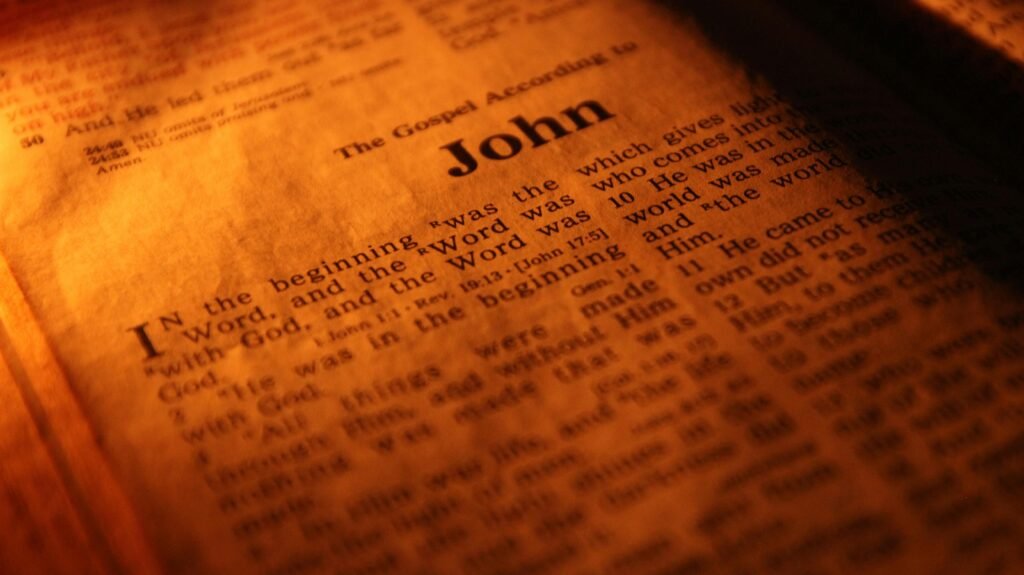
In the beginning was The Word, and The Word was with God, and The Word was God.
John 1:1
Greek (Koine) Ἐν ἀρχῇ ἦν ὁ λόγος (en archḗ ēn ho lógos) καὶ ὁ λόγος ἦν πρὸς τὸν θεόν (kai ho lógos ēn pros ton theón) καὶ θεὸς ἦν ὁ λόγος (kai theós ēn ho lógos)
One sentence. Three clauses. No runway.
This is not a poetic flourish nor a narrative hook. It is a theological declarationdesigned to orient the readerbefore anything else can be said.
John establishes ontologybefore biography — beingbefore action.
And then one day you find
Ten years have got behind you…
Clause 1 — In The Beginning Was The Word
In The Beginning (Ἐν ἀρχῇ / en archḗ)
John does not warm you up, nor does he offer a soft on-ramp into theology. He reaches back past Bethlehem, past Abraham, past Adam — and plants his flag before creation ever clocks in. He does not say At the beginning. He says In the beginning. That matters.
Matthew opens with Jesus in history and lineage. Mark moves quickly to the narrative of John the Baptizer. Luke begins like a careful historian, with a formal preface and birth narratives.
John skips genealogy, skips birth narratives, skips scene-setting altogether — and startsbeforetime itself.
This is not “once upon a time.” This isἘν ἀρχῇ (en archḗ).
This is a deliberate echo of Genesis 1:1 — בְּרֵאשִׁית (berēʾšît)
"In the beginning, God created the heavens and the earth." (Genesis 1:1)
The phrase ἐν ἀρχῇ does not mean “at creation,” but “prior to all created time“—not the beginning of creation, butbefore creation had a beginning.
John is placing us— outside the created order—outside of the first tick on the global clock.
Was (ἦν / ēn)
And here is the first hammer blow: John crucially uses ἦν (ēn, “was”) rather than ἐγένετο (egéneto, “came into being”) — signaling eternal, continuous, and unoriginated existence. John does not use a verb that means came into being. He uses was.
The Word (ὁ λόγος / ho lógos)
λόγος (lógos) denotes not merely speechoridea, butGod’s active, self-expressive power.
God’s Wordis not an abstraction. God’s Wordis not a sound. God’s Wordis not a philosophical principle.
In Israel’s Scriptures, God’s Word is active, effective, and personal in operation.
John does not import Greek abstraction but rather recasts Israel’s Word-and-Wisdom theology in Greek linguistic form — declaring something outrageous:
That Word is a Who.
"By the word of the LORD the heavens were made,
and by the breath of His mouth all their host." (Psalm 33:6)
Psalm 33:6 deliberately pairs “the word of the LORD” with “the breath of his mouth.” The Hebrew concept underlying breath is ַרוּחַ (rûaḥ) — meaning breath, wind, or spirit. Word and Spirit are distinct yetinseparable in God’s creative action, a pattern that undergirds John’s Logostheology.
"For as the rain and the snow come down from heaven
and do not return there but water the earth...,
so shall my word be that goes out from my mouth;
it shall not return to me empty,
but it shall accomplish that which I purpose." (Isaiah 55:10-11)
In the Tanakh, God’s Word is the effective agent of creation, not a mere utterance but the means by which divine will becomes reality. God creates by speaking. His Word goes forth and accomplishes what He purposes. It never returns empty-handed.
When John uses ἦν (ēn, “was”) with λόγος (Logos) as the persistent subject, he is both declaring the eternal existence and divine nature of The Word, while also establishing an ontological boundary: whatever comes into being does so later.
This grammar alone excludes The Logos from the created order and forecloses any reading that treats the Son as the highest creature.
The Worddidnotbegin. The Worddid notemerge. The Worddid notevolve.
The Word already was.
If you miss that, you miss everything.
No one told you when to run
You missed the starting gun…
Clause 2 — And The Word Was With God
With God (πρὸς τὸν θεόν / pros ton theón)
The Word is notnear God. The Word is notalongside God.
The Word isdistinct from God yet eternally oriented toward Him.
"then I was beside Him, like a master workman,
and I was daily His delight,
rejoicing before Him always." (Proverbs 8:30)
The imagery is not spatial distance but relational delight and intimate fellowship.
with God (πρὸς τὸν θεόν / pros ton theón)
John says exactly what he means, and he structures the sentence so you cannot downgrade it without breaking the Greek. πρός (pros) conveys dynamic orientation toward — not static proximity. The Greek here carries the sense of personal communion — face-to-face relationship, shared presence. The Word is not an impersonal force. He is not God’s mood nor His internal monologue. The Word shares the very nature of God.
Distinction without separation.
The Word is not the Father. The Word is not created by the Father. The Word is eternally with the Father.
That may be unsettling to modern sensibilities, but truth does not bend to the preferences of its audience before it speaks.
And you run, and you run To catch up with the sun, but it’s sinking…
Clause 3 — And The Word Was God
And here is where John refuses to let the reader sit comfortably.
θεός (theós) is anarthrous (no article). The emphasis is on nature, not identity confusion.
He does not say The Word was a god. He does not say The Word was like God.
He says The Word was God.
Not the same person as the Father — but fully sharing the divine nature. John affirms full deity without modalism or subordination.
No dilution. No hierarchy. No wiggle room.
This claim does not emerge in a vacuum. John has hyperlinked the reader back to the opening chapter of Genesis, which more than hints at personal plurality within the one and only God: John offers no middle ground.
The Word is either fully God — or John is a blasphemer.
There is no polite option three.
"Then God said, 'Let Us make man in Our image, after Our likeness.'" (Genesis 1:26)
Genesis 1:26 does not articulate the Trinity explicitly, yet its plural deliberation accords with John’s later revelation of personal distinction within the Godhead. The plural deliberation does not fracture monotheism, yet it resists reduction to a solitary divine monad. John 1:1 confirms what Genesis gestures toward: personal distinctionwithinone divine being.
John never introduces God the Father by name in John 1:1, and this is not an omission — it is a strategy.
Instead, John does something deliberate and theologically precise:
Clause 1 establishes eternal existence (“In the beginning was the Word”)
Clause 2 establishes personal distinction and communion (“the Word was with God”)
Clause 3 establishes shared divine nature (“the Word was God”)
By structuring the sentence this way, John resolves the deepest theological tension before it can even be raised. He affirms full deity without collapsing persons, and distinction without dividing essence — all without yet naming the Father explicitly. The identity of “God” is allowed to emerge relationally rather than propositionally.
This also explains John’s precision with articles:
ὁ θεός — the Father, as person
θεός — the divine nature fully shared by The Word
John does not argue the deity of The Word; he states it, and then moves on — the grammar does the work.
This is not evasive theology — it is economical revelation.
And racing around To come up behind you again
The opening verse of John’s Gospel does not invite you into a discussion. It does not take its time to build a compelling argument. It confronts you with a reality.
He anchors identity in being, not in self-definition.
Before The Logos does anything — before He teaches, heals, dies, or rises — John tells you who He is.